

thumbnail image
  • Home
  • People
  • Research
  • Publications
  • Openings
  • …  
    • Home
    • People
    • Research
    • Publications
    • Openings
  • Home
  • People
  • Research
  • Publications
  • Openings
  • …  
    • Home
    • People
    • Research
    • Publications
    • Openings
  • Left to right: (1-2). TEM image of a TiO2-coated AFM tip and its electron diffraction pattern; (3) SEM image of a WC-coated surface with a hierachical self-similar morphology, reminiscent of a close-up view of broccli; (4) A graphene/graphite flake exfoliated onto a SiO2 substrate; (5) AFM image of the atomic steps on a graphite surface; (6) Optical image of a superlubric micro-slider under the manipulation of a tip; (7) SEM image of another superlubric micro-slider which is rotationally misaligned.

    Left to right: (1-2). TEM image of a TiO2-coated AFM tip and its electron diffraction pattern; (3) SEM image of a WC-coated surface with a hierachical self-similar morphology, reminiscent of a close-up view of broccli; (4) A graphene/graphite flake exfoliated onto a SiO2 substrate; (5) AFM image of the atomic steps on a graphite surface; (6) Optical image of a superlubric micro-slider under the manipulation of a tip; (7) SEM image of another superlubric micro-slider which is rotationally misaligned.

  • Mechanics and Tribology at Micro/Nano Interfaces
    Section image

    Welcome!


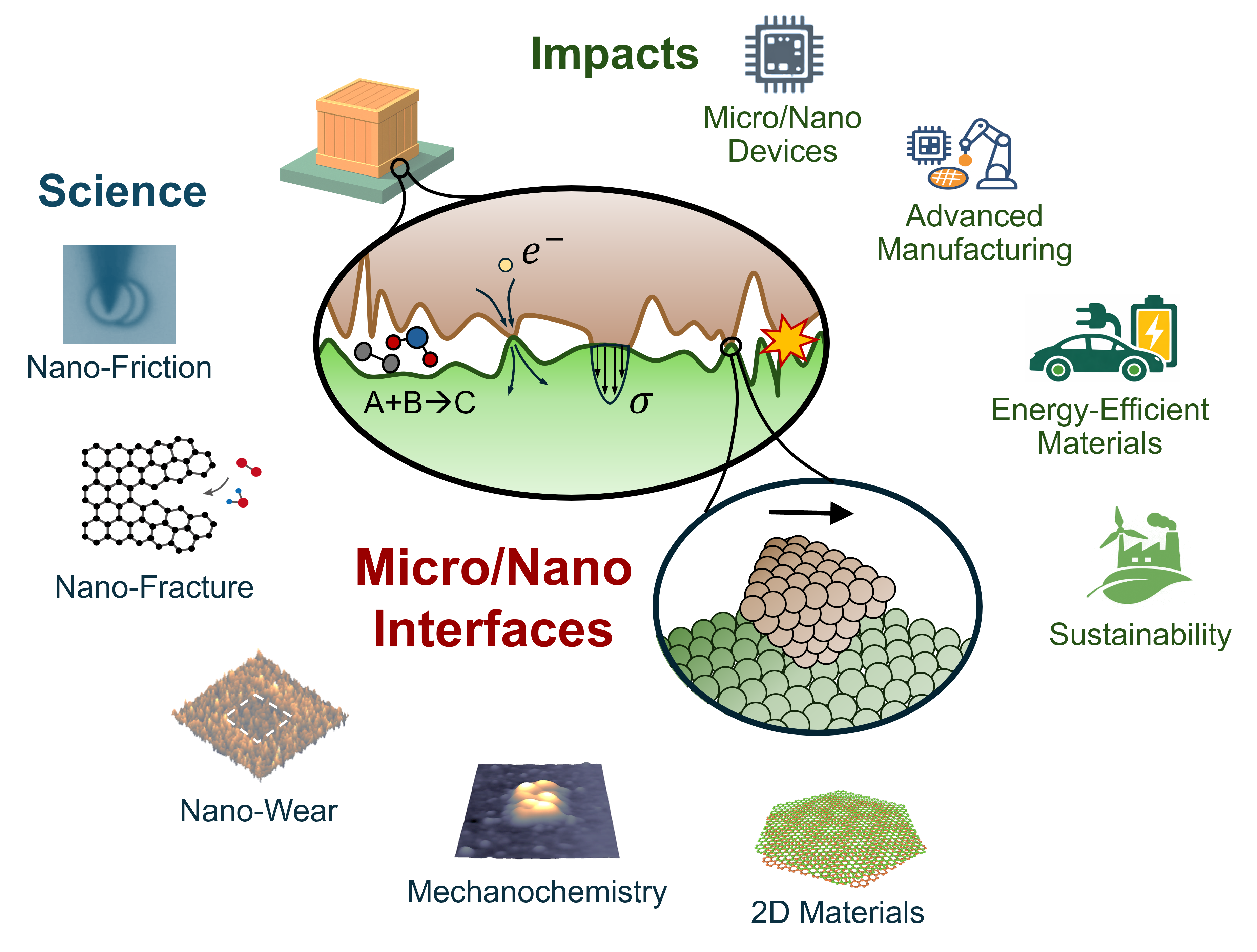
    Solid interfaces are ubiquitous in natural and engineering systems, having a strong impact on the efficiency and reliability of nearly all mechanical devices—from automobile engines to individual nanoscale contacts. At these interfaces, friction, fracture, wear and stress-induced chemical reactions contribute significantly to global energy dissipation and material degradation. Meanwhile, rapid developments in nanomechanics and nanotribology are uncovering new phenomena at small scales, enabling potentially transformative applications.

    Our research explores the mechanics and tribology of solid interfaces at the micro- and nanoscales, aiming to understand the fundamental mechanisms of energy dissipation, transformation, and failure at these tiny contacts. We are particularly interested in the unusual behaviors that differ fundamentally from the macroscopic world, with implications for micro/nanodevices, manufacturing, energy efficiency, and sustainability.

    We use a range of nanomechanics experimental tools such as atomic force microscopy, and combine them with theoretical models, seeking simple but elegant physics understanding of complex phenomena whenever possible.

Last updated: 2026-1

Cangyu Qu Research Group
https://user-assets.sxlcdn.com/images/1276782/FlMoZZuoX2FRW3FLvxScTwIL9AdX.png?imageMogr2/strip/auto-orient/thumbnail/1200x630>/format/png
Cookie的使用
我们使用cookies来确保流畅的浏览体验。若继续,我们认为你接受使用cookies。
了解更多