
Current Research
Mechanochemistry
Mechanochemistry is the concept of controlling chemical reactions directly by force or stress. It plays crucial roles in many engineering systems across length scales, from automobile engines to micro-/nanoelectromechanical systems (MEMS/NEMS). Owing to its potential of enabling solvent-free and highly selective chemical reactions, it is also considered an environmental-friendly chemical synthesis route. We aim to establish a mechanics-based understanding of mechanochemistry to address fundamental challenges in this emerging field. Our goal is to develope universal theoretical and experimental methods that in turn advance the quantitative understanding and control of force-driven chemical reactions in practically important systems.
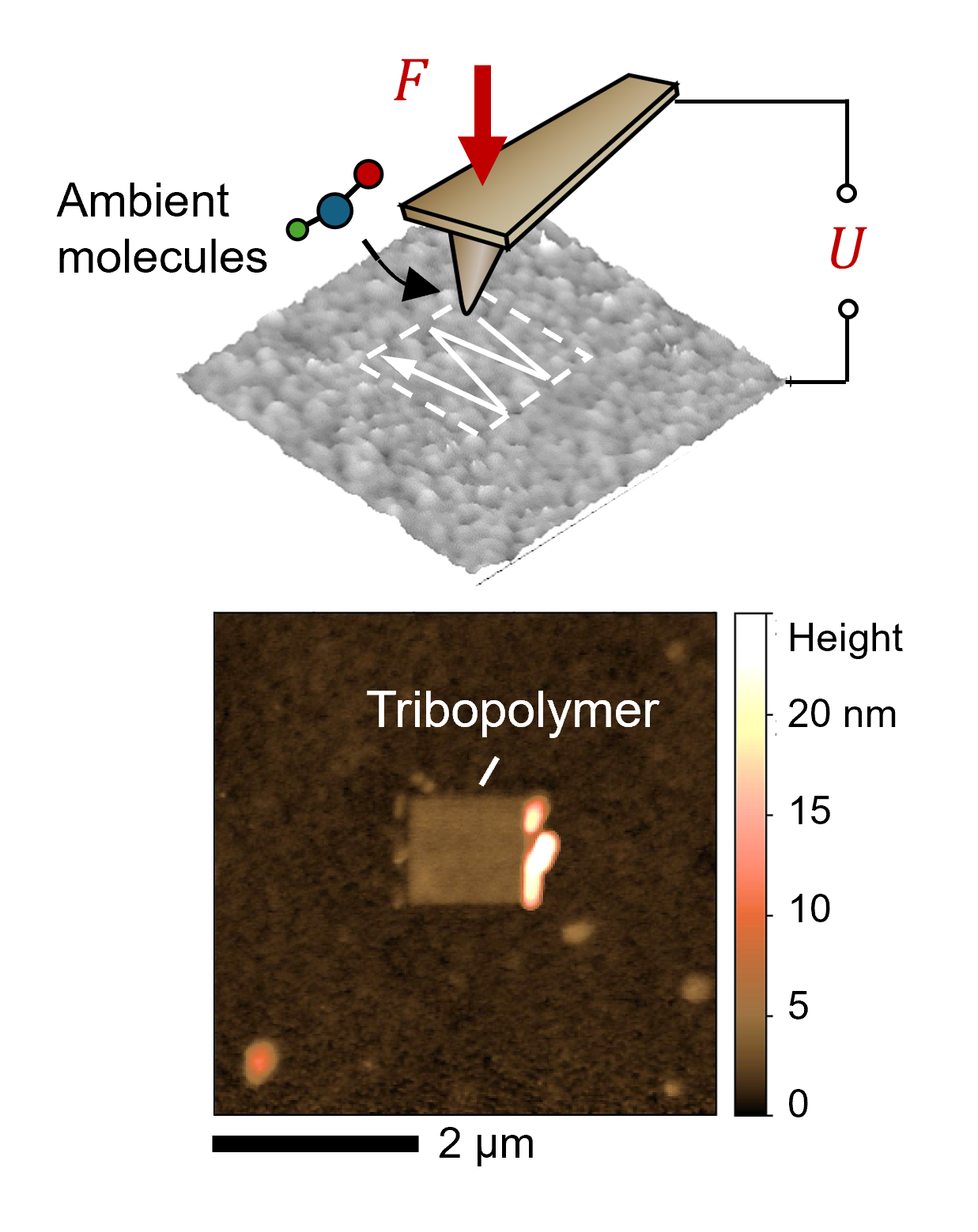
Cangyu Qu, Robert W. Carpick*. ACS Appl. Mater. Interfaces 17, 56593 (2025)
Mechanochemistry at Nanoscale Metallic Contacts: How Stress and Voltage Drive Tribopolymerization
Paper link (featured as front Cover)
Ambient hydrocarbon molecules unbiquitously adhere to nearly all solid surfaces and, under friction, can react to form thin insulating films—a process called tribopolymerization. In nanoelectromechanical systems (NEMS), these films degrade the conductivity of electrical contacts and therefore constrain their lifetime. Using atomic force microscope (AFM) combined with a mechanics-based model, we uncover how stress and electric fields cooperatively drive this reaction and limit the reliability of nanoscale devices.
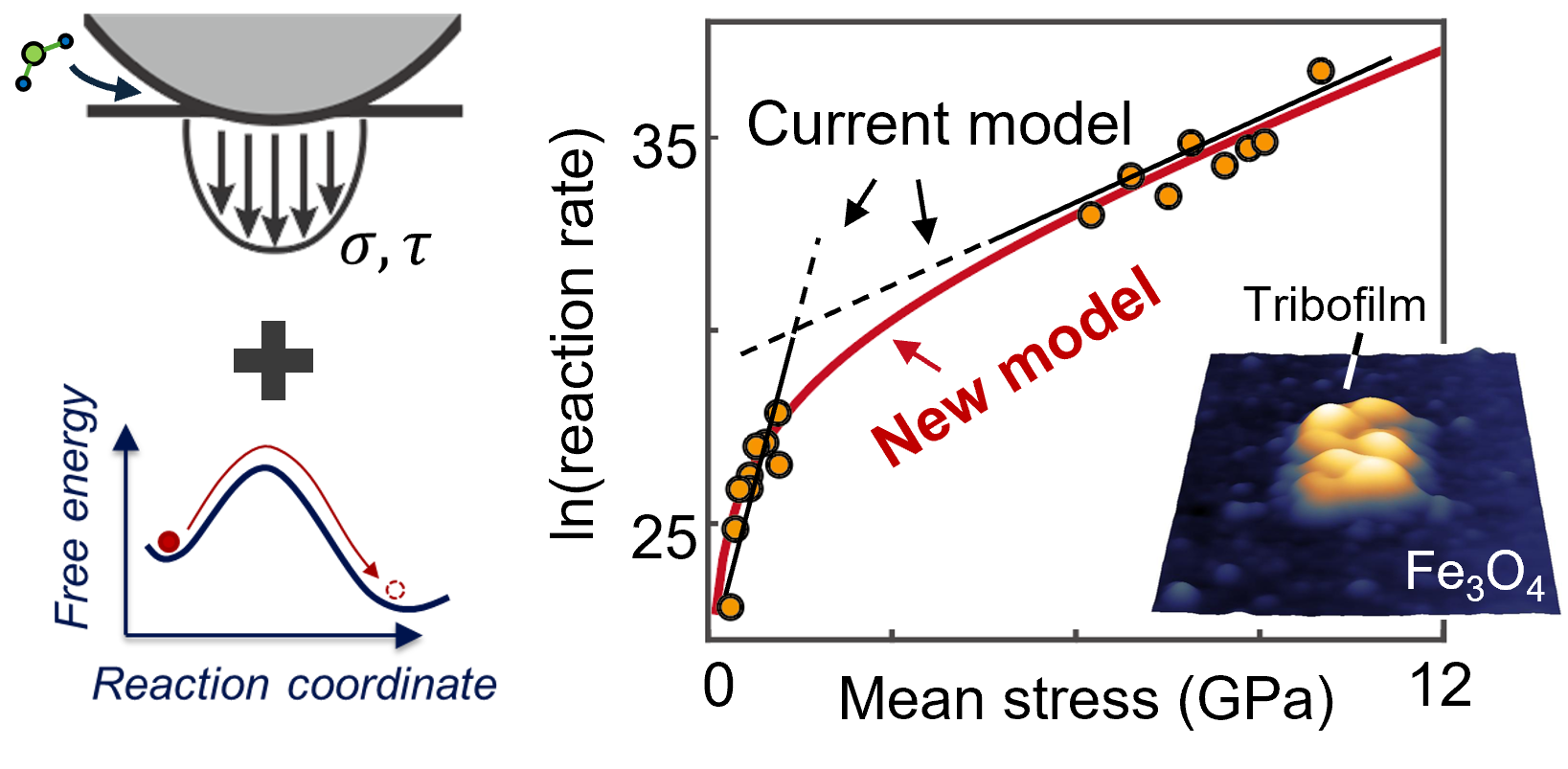
Cangyu Qu, Lu Fang, Robert W. Carpick*. Phys. Rev. B 111, 195405 (2025)
Contact Mechanics Correction of Activation Volumes in Mechanochemistry
In mechanochemistry, rubbing surfaces can trigger chemical reactions. How efficiently stress accelerates these reactions is described by a parameter named activation volume. However, quantitatively measuring activation volume has been surprisingly inconsistent. Our research reveals that previously ignored mechanical factors can distort these measurements, leading to large errors. A corrected model is developed based on contact mechanics theory to resolve this large discrepancy in existing literature.
Nanomechanics of 2D Materials
Two-dimensonal (2D) materials with single- to few-atoms thickness exhibit unique properties different from their bulk counterparts. Understanding their mechanical behaviors including strength, flexibility, and failure is key to a variety of relevant applications, such as 2D-materials-based sensors and flexible electronics. However, due to the tiny length sclaes involved, it often requires advanced tools and clever experimental design. We use nanomechanics tools to study the mechanics and physics of 2D materials, with a focus on its fracture mechanics and interlayer behaviors.
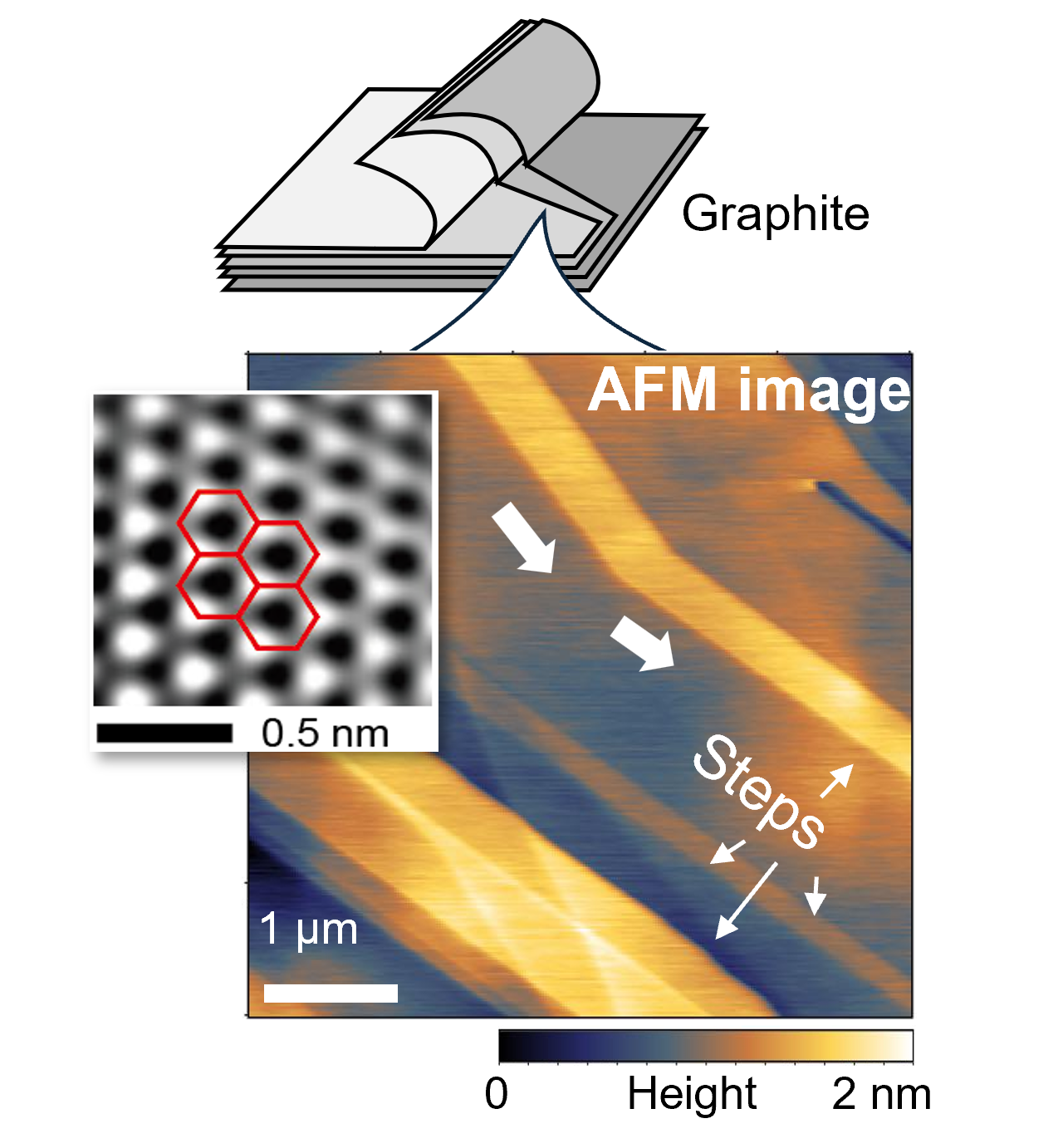
Cangyu Qu*, Diwei Shi, Li Chen, Zhanghui Wu, Jin Wang, Songlin Shi, Enlai Gao, Zhiping Xu, Quanshui Zheng*. Phys. Rev. Lett 129, 026101 (2022)
Anisotropic Fracture of Graphene Revealed by Surface Steps on Graphite
Graphene, a one-atom-thick sheet of carbon, is renowned for its exceptional mechanical strength. But its resistance to fracture is not uniform in all directions. By examining the atomic-scale surface steps left behind after exfoliation, we show that graphene fractures more easily along certain orientations. This directional dependence, known as anisotropic fracture, is crucial for the functioning of graphene-based devices and relevant to a unique toughening mechanism in 2D materials.
Structural Superlubricity
Friction and wear cause significant energy losses and equipment failures globally. Structural superlubricity is a phenomenon of near-frictionless sliding without the use of any lubricants. It arises from the special arrangement of atoms at the contacting surfaces. This unique phenomenon offers potentially revolutionary strategy for solving friction and wear problems, particularly on nano- and microscales. We use a microscale superlubric system to explore unusual mechanical behaviors under this near-zero friction condition and study their fundamental mechanisms.
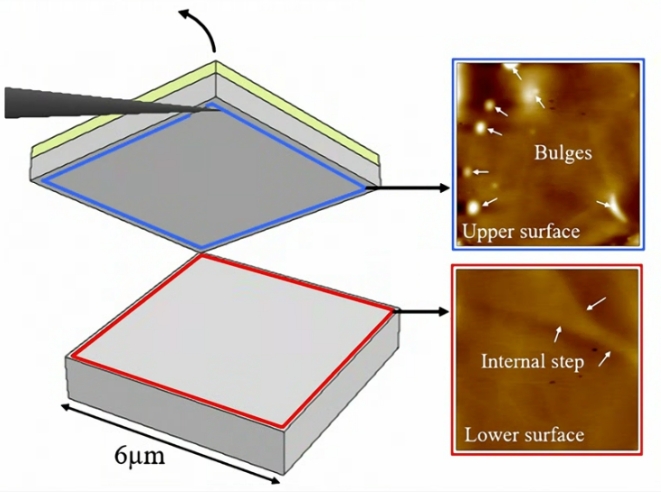
Kunqi Wang, Cangyu Qu*, Jin Wang, Baogang Quan, Quanshui Zheng*. Phys. Rev. Lett. 125(2), 026101 (2020)
Characterization of a Microscale Superlubric Graphite Interface
Paper link (featured as editors' suggestion)
Directly characterizing both surfaces of a solid-solid contact is essential but challenging at the nanoscale. Using a new "pick-and-flip" technique, we reveal the hidden interfaces in superlubric contacts. We confirm that superlubricity arises from two misaligned crystalline surfaces and show that its failure is caused by external defects—explaining why only some contacts exhibit superlubricity while others do not.
Cangyu Qu, Kunqi Wang, Jin Wang, Yujie Gongyang, Robert W. Carpick, Michael Urbakh, Quanshui Zheng*. Phys. Rev. Lett. 125(12), 126102 (2020)
Origin of Friction in Superlubric Graphite Contacts
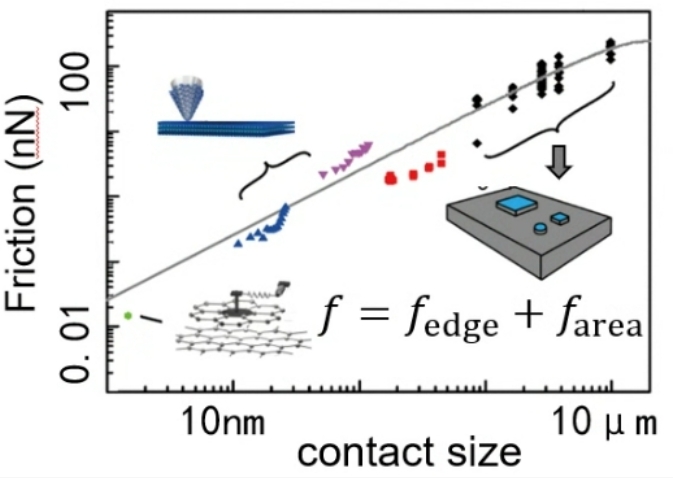
Classical theories of superlubricity consider ideal, infinitely-large contacts. Here, for real, finite-sized superlubric contacts, we experimentally decouple the friction contributions from the contact area and the contact edges. We found that the tiny residual friction in superlubricity originates from the edges: each edge atom contributes >10,000 times more friction than an atom inside the contact. These results, along with a derived scaling law, provide clear guidance for designing large-scale, ultra-low-friction interfaces.
Cangyu Qu, Songlin Shi, Ming Ma, Quanshui Zheng*. Phys. Rev. Lett. 122(24), 246101 (2019)
Rotational Instability in Superlubric Joints
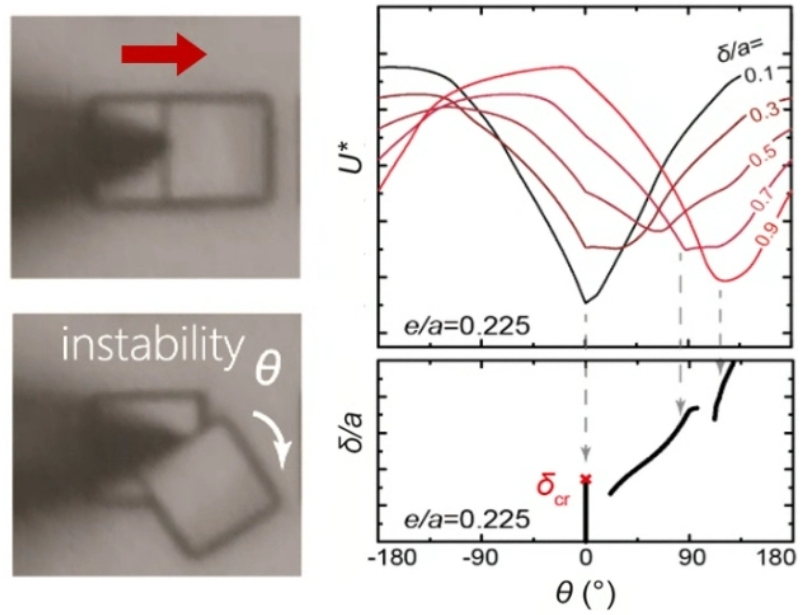
Instabilities driven by surface energy are common in liquids but typically suppressed in solids by elasticity and plasticity. In microscale superlubric contacts, however, surface energy can become dominat. We uncover such an instability in a superlubric slider, where a sliding graphite flake suddenly transitions from pure translation into rotation at a critical displacement when pushed by a micro-tip. With a simple mechanics model, we show that this instability is driven by surface energy minimization. This highlights how surface energy governs the dynamics of superlubric systems and offers a new actuation principle for micro- and nanoscale devices.
